In my last article I described how the new CMS rules define what constitutes a “community” setting for purposes of Medicaid funding.
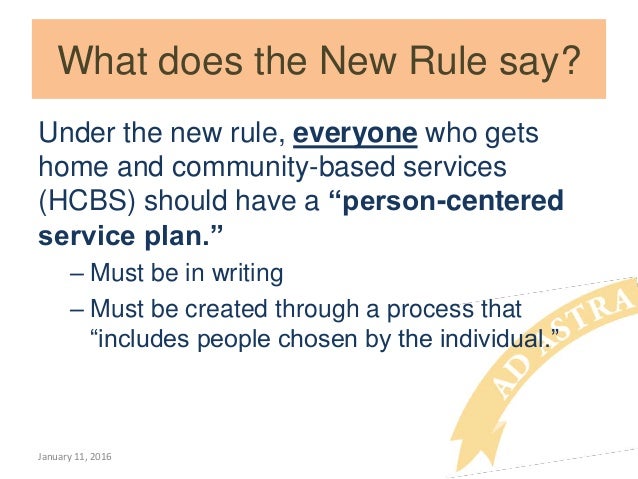
I mentioned that the rules permit some aspects of the definition to be altered if the alteration is justified in an individual’s “person-centered” plan. In addition, the very first requirement in the CMS rules for a community setting is that the setting have a person-centered planning process that meets the requirements that are set out in the rules. Therefore, it is important that all families understand the person-centered planning process requirements in the new CMS rule and the role we, as legal guardians of our family members, will play in that process.
We are all very familiar with the annual service plans that we currently develop along with the Misericordia staff for our family member. Misericordia has for many years been committed to person-centered planning and making sure that the annual service plan for each individual is tailored to that individual’s needs and preferences. However, the CMS rules require a very significant change in this annual planning process. The rules require that starting in March 2019, the plan must not be developed by anyone affiliated with the entity providing services under the plan (i.e., Misericordia). Instead, the plan must be developed by an independent third party. In our case, the annual person-centered plan will likely be developed by a person at our PAS agency, Community Alternatives. The reason for this requirement is a concern that providers of services may have a conflict of interest. CMS is concerned that the provider of services, in our case Misericordia, will have an interest in developing plans that specify the services and activities that the provider offers, rather than the services and activities that the individual needs or wants. While this has not been our experience at Misericordia, it is nonetheless a requirement of the new rule that will go into effect in March 2019. Of course, the downside to this new requirement is that the “person-centered” plan will be developed by someone who does not know our family member. This emphasizes the importance of our role as parents and siblings in making sure that these annual plans reflect what we believe our family member wants and needs.
Another important aspect of the person-centered planning rule is that it provides that the individual receiving services “will lead the person-centered planning process where possible.” However, the rule goes on to say: “The individual's representative should have a participatory role, as needed and as defined by the individual, unless State law confers decision-making authority to the legal representative.” This sentence is very important, especially the portion I have underlined. The “individual’s representative” is the parent or sibling. The rule first confines our role as “participatory, as needed and as defined by” our family member. However, the rule then recognizes that state law may provide a much more significant role for legal guardians and CMS does not have the power to change state law. Under Illinois law, the legal guardian of a disabled adult has broad powers. Illinois law says that the legal guardian “shall make provision for [the disabled adult’s] support, care, comfort, health, education and maintenance, and professional services as are appropriate.” The Illinois guardian statute also says that “[t]he guardian shall assist the ward in the development of maximum self-reliance and independence.” Finally, the Illinois statute contains detailed guidelines on how we, as our family members’ guardians, should make decisions on behalf of our family members:
“Decisions made by a guardian on behalf of a ward shall be made in accordance with the following standards for decision making. Decisions made by a guardian on behalf of a ward may be made by conforming as closely as possible to what the ward, if competent, would have done or intended under the circumstances, taking into account evidence that includes, but is not limited to, the ward's personal, philosophical, religious and moral beliefs, and ethical values relative to the decision to be made by the guardian. Where possible, the guardian shall determine how the ward would have made a decision based on the ward's previously expressed preferences, and make decisions in accordance with the preferences of the ward. If the ward's wishes are unknown and remain unknown after reasonable efforts to discern them, the decision shall be made on the basis of the ward's best interests as determined by the guardian. In determining the ward's best interests, the guardian shall weigh the reason for and nature of the proposed action, the benefit or necessity of the action, the possible risks and other consequences of the proposed action, and any available alternatives and their risks, consequences and benefits, and shall take into account any other information, including the views of family and friends, that the guardian believes the ward would have considered if able to act for herself or himself.”
We need to remember that we were appointed the legal guardian of our family member because a court determined that he or she is unable to make decisions for him or herself. Therefore, as legal guardians for our loved ones, we are empowered to make decisions for them based on what we believe is in their best interests. It is a role we must exercise in the new person-centered planning process.
In a future article, I will go into further detail on the specific aspects of the person-centered planning process where we as legal guardians will play an important role.
Please feel free to contact me with any questions or comments at This email address is being protected from spambots. You need JavaScript enabled to view it..
Scott